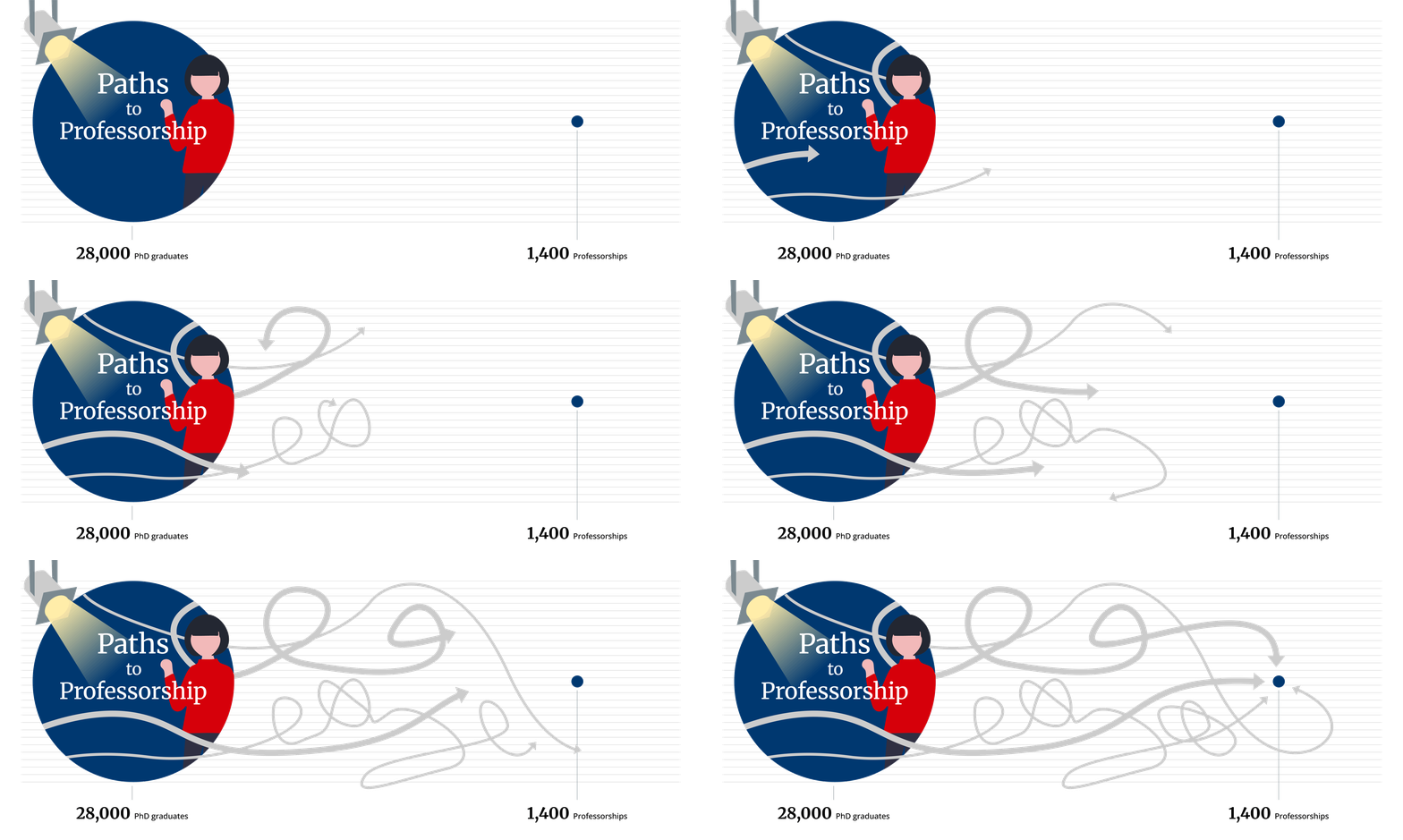
What 18 professors from the Berlin University Alliance reveal about their actual career paths — and what that means for postdocs today.
18
Professors
25+
Countries
7–21
Years PhD → Chair
Read on
The path to a professorship is rarely the straight line that junior researchers imagine — or fear they’re failing to walk. Based on in-depth interviews with 18 professors across the Berlin University Alliance, this longread maps what their careers actually looked like: the detours, doubts, accidents of timing, and moments of clarity that shaped each journey. The data may surprise you.
Chapter 1
The Myth of Perfect Planning
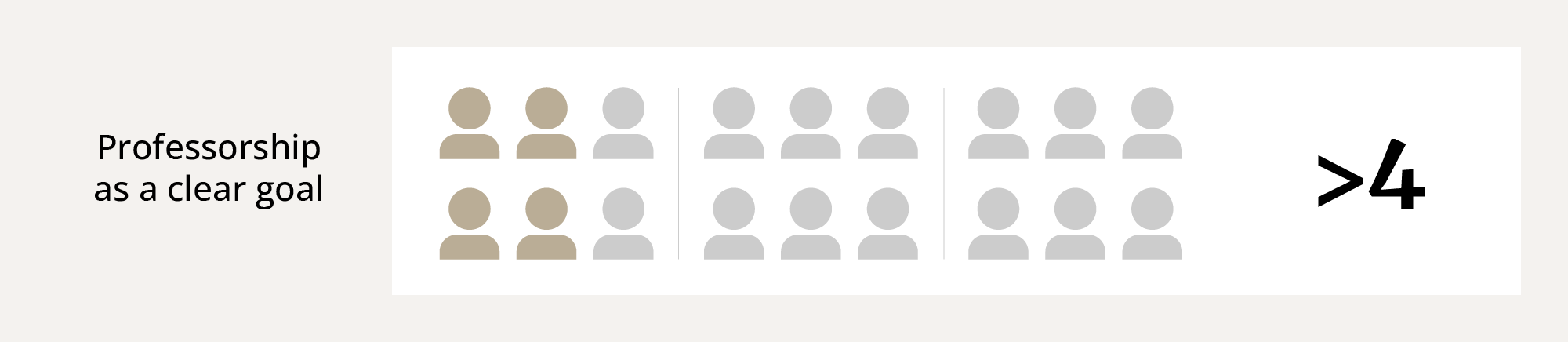
When we asked our interview partners about the moment they decided to pursue an academic career, a striking pattern emerged: the decision came late — if it was conscious at all. Of the 18 professors we spoke with, fewer than 4 had professorship as a clear goal during their doctoral studies. The majority described their path as “keeping options open” or “developing organically.”
This held true across all disciplines. The lack of early planning wasn’t a discipline-specific phenomenon; it appears to be a fundamental characteristic of successful academic careers.
What does this mean? The pressure many postdocs feel to have had their career mapped out from the beginning is not only unrealistic but potentially counterproductive. The path to professorship was rarely a straight line — but a series of decisions made at crucial junctures, each opening new possibilities.
The Unplanners
Professors reflecting on careers that evolved without a master plan
Audio Snippet
From the podcast series “Wege zur Professur”
What initially seems like a lack of ambition reveals itself as a fundamental success principle. Those who maintained flexibility were better positioned to seize opportunities. This is what we call strategic flexibility: openness to opportunities combined with concrete preparation for them.
16 out of 18 professors had serious alternative career plans: banking, legal practice, industry R&D, science journalism, NGO work, or entrepreneurship. This optionality didn’t weaken their commitment to research — it strengthened their resilience.
Chapter 2
When “Chance” is Strategically Prepared
When we analyzed the pivotal moments in our professors’ careers — the job offer that came out of nowhere, the perfect timing of a position opening, the mentor who made a crucial introduction — a pattern emerged. These weren’t random events. They were the result of years of invisible groundwork.
“Windows open, and then you have to walk through them. They don’t last forever and they don’t come often.”
— Wolfgang Kübler, Professor of Physiology
Take unsolicited job offers, which occurred in the careers of 7 out of 18 professors. These didn’t materialize from thin air — they came because of strong publications, visibility at international conferences, and reputations built through years of solid work.
The Mentor-Mediated Opportunity
“You can get a sense of what questions might arise if people understand about 80% of what you’ve told them.”
— Professor of Pediatric Pulmonology
In roughly one-third of cases, a crucial career step came through a mentor’s recommendation. Mentors intervened for those whose work they had observed closely and whose capabilities they could vouch for. The lesson: work in ways that make your capabilities visible to those who can open doors.
The Conference Connection
Nearly all professors could point to at least one conference that proved pivotal — but they often couldn’t have predicted which one it would be. Consistent conference participation, rather than selective attendance at only “the most important” venues, may be more valuable than commonly assumed.
Chapter 3
The Paradox of Self-Doubt
One of the most unexpected findings: more than two-thirds of our interview partners explicitly described periods of significant self-doubt during their postdoc years. This wasn’t occasional impostor syndrome — it was persistent questioning of whether an academic career was even realistic.
“I think I underestimated my own science back then.”
— Sina Bartfeld, Professor of Medical Biotechnology
Self-doubt may actually be a normal — even characteristic — part of successful academic careers. The constant self-questioning drives continued learning, prevents complacency, and maintains intellectual humility. The key difference: whether doubt leads to action or to inaction.
The Value of Presence
On doubt, visibility, and showing up — even when uncertain
Audio Snippet
From the podcast series “Wege zur Professur”
Chapter 4
The Academic Life: How Long Does It Actually Take?
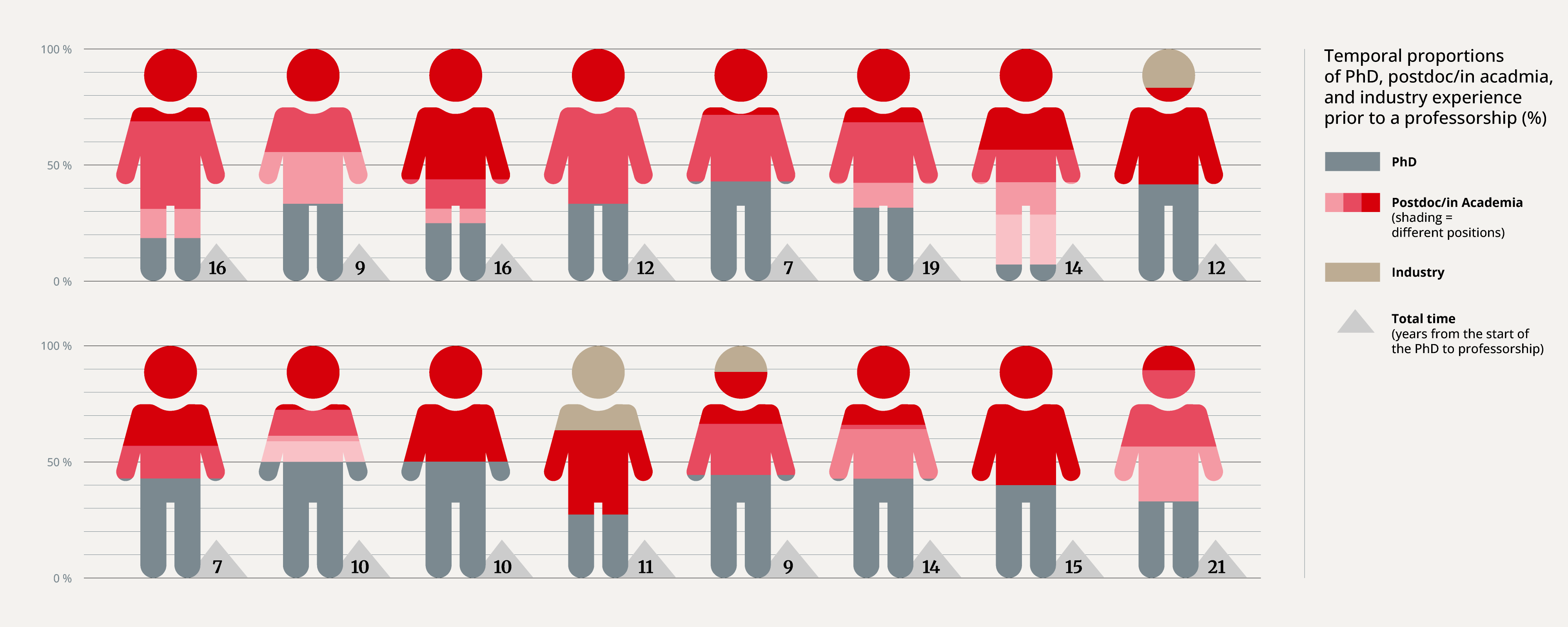
The time from the start of the PhD to a first professorship ranged from 7 to 21 years. There is no single “on-time” trajectory. The graphic below visualizes all 18 profiles, showing how PhD time, postdoc phases, and (in rare cases) industry experience composed each career.
Temporal proportions of PhD, postdoc/academia, and industry experience prior to professorship. Numbers = total years from PhD start to first chair.
While most professors spent the majority of their pre-chair career in academic positions, the ratio between PhD duration and postdoc time varies substantially. What mattered was the quality of each phase, not its duration.
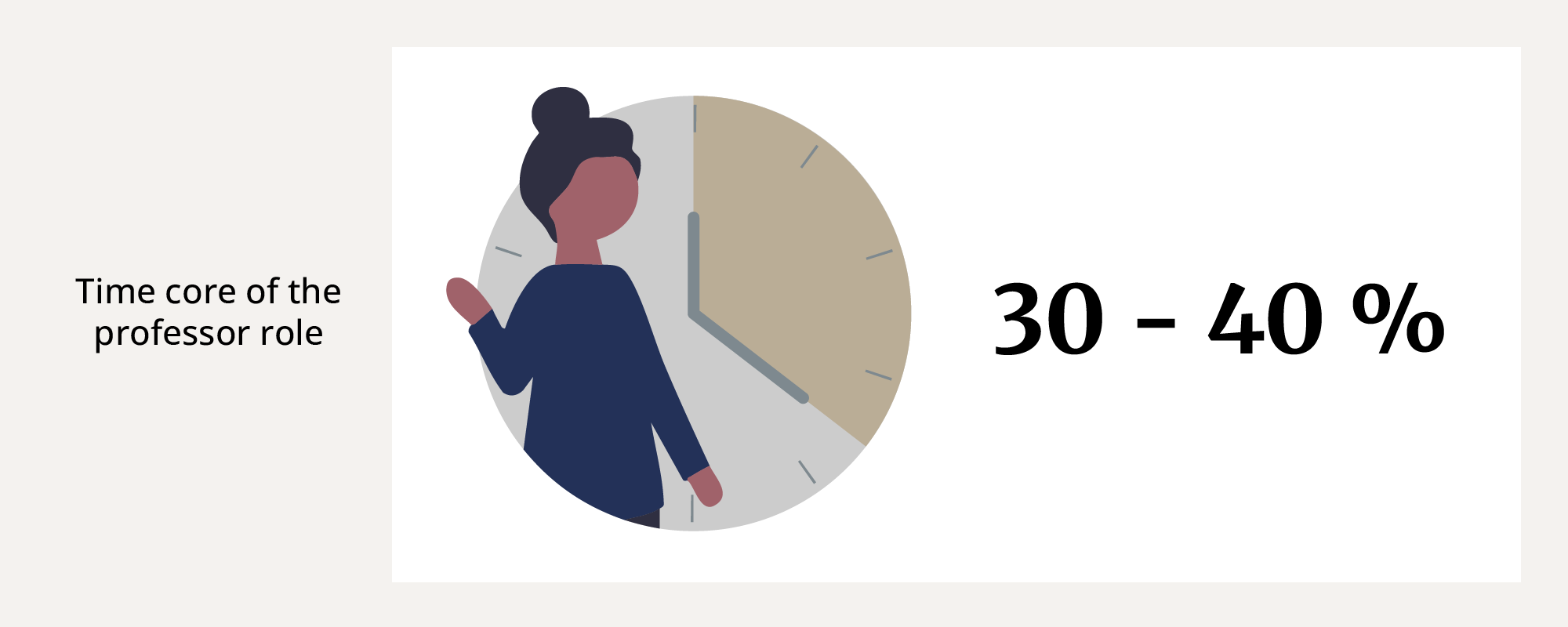
Once in a professorship, actual research time represents only 30–40% of the role. Teaching, administration, and leadership responsibilities are far larger than most postdocs anticipate.
Chapter 5
The Geography of Success
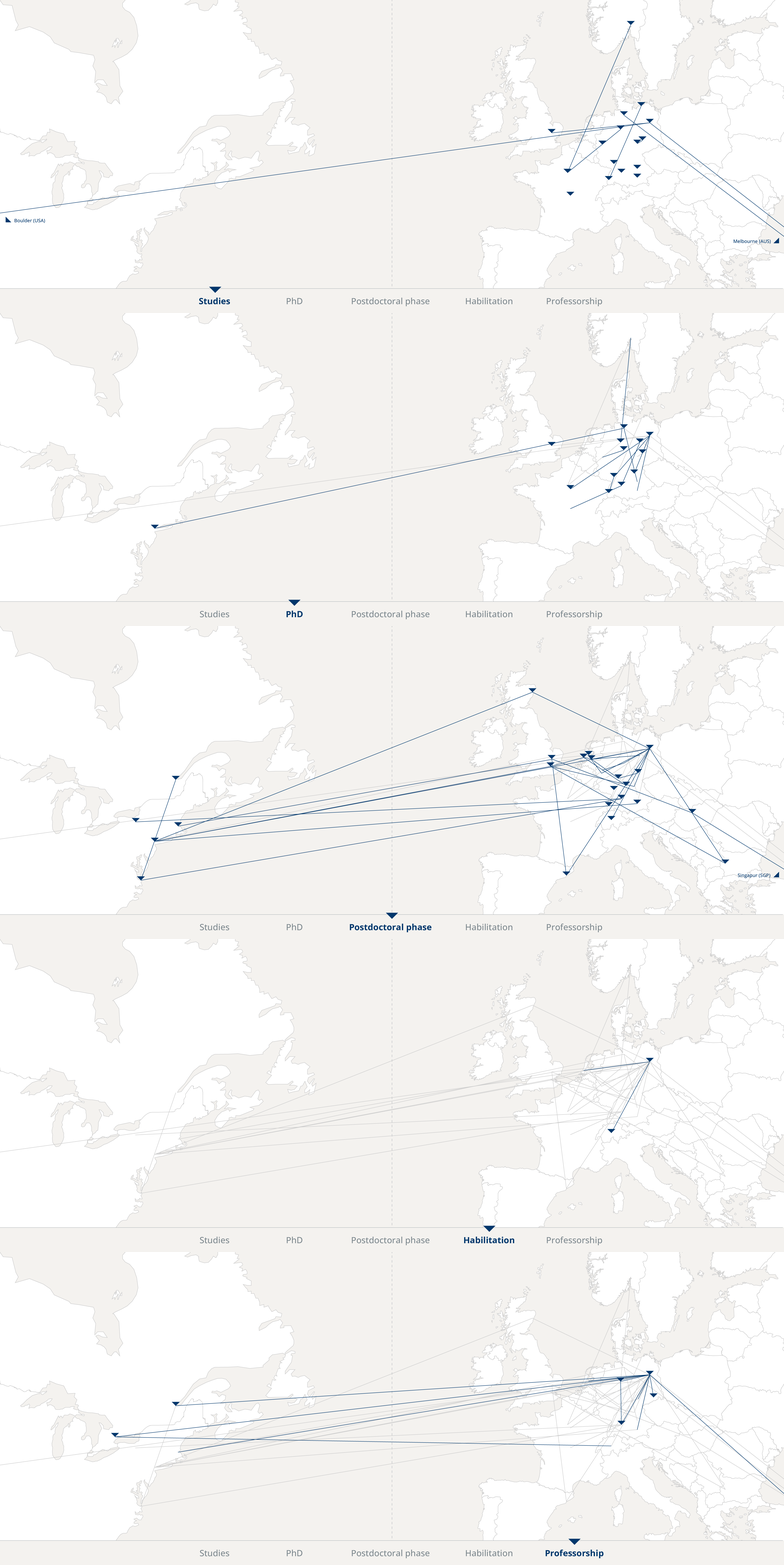
Our 18 professors accumulated professional experience in over 25 different countries across six continents. The average professor had lived and worked in at least three different countries during their career. What mattered wasn’t the quantity of international experience but what happened during those periods: perspective shifts, network-building, and skill development.
Countries of professional experience for all 18 interview partners. USA, UK, Netherlands, Switzerland, and France appear most frequently.
Crucial Caveat
Not everyone went abroad extensively — and those who didn’t still succeeded. One econometrician reflected that it “would have gone better if I had risked more and gone abroad” — but still achieved a successful career.
Chapter 6
Plan B as Strategic Advantage
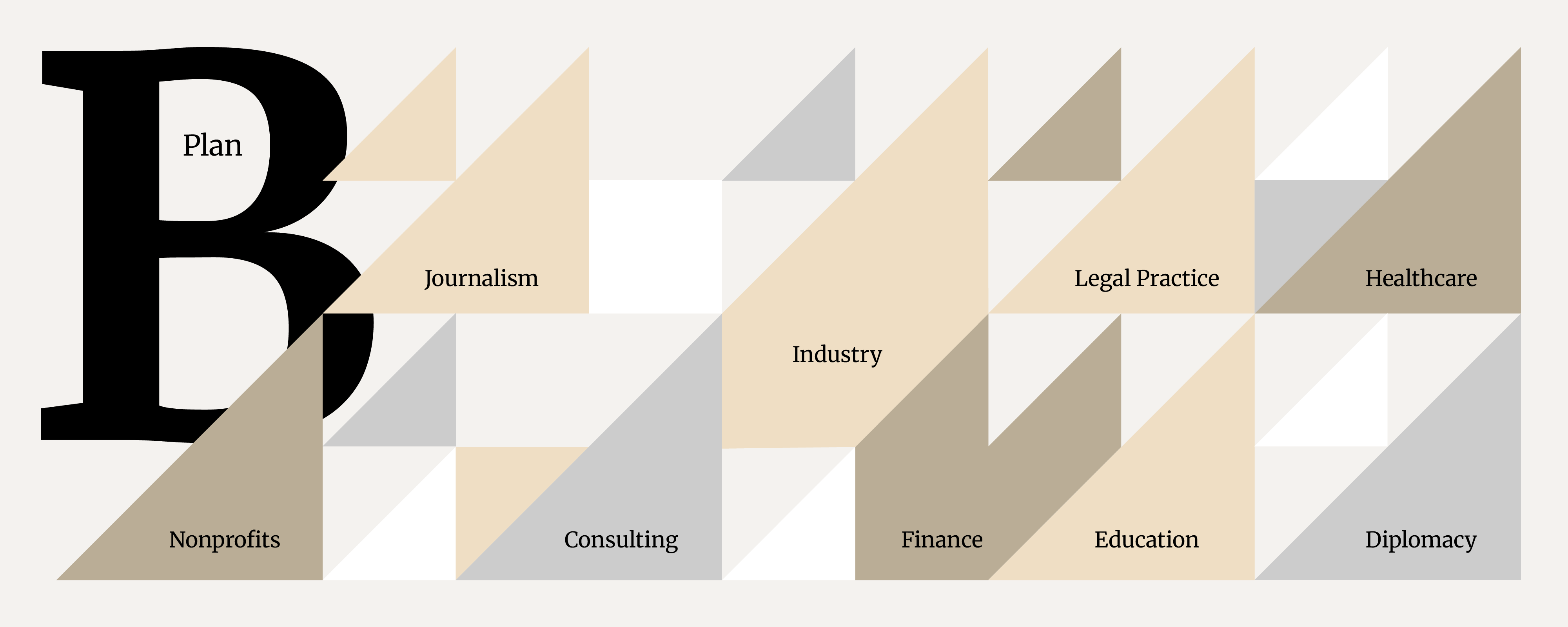
Having serious alternatives to academia wasn’t a weakness — it was consistently described as a strength. 16 of 18 professors had concrete Plan Bs at various points. When you know you have alternatives, each decision in academia becomes a choice rather than a necessity.
“I had decided for myself that I’m not going to big industry, I’m not going to small industry either. I want a professorship, so I have to go to the person in my field from whom I think I’ll learn the most.”
— Vera Meyer, Professor of Applied and Molecular Microbiology
Plan B also served a less obvious function: it kept professors honest about whether they actually wanted to continue in academia. Those who did continue made an active, informed choice.
Non-academic alternatives seriously considered by interview partners: journalism, consulting, industry, legal practice, finance, healthcare, nonprofits, education, and diplomacy.
Chapter 7
The Job Talk: Demystifying the “Vorsingen”
The German academic job talk looms large in postdoc anxieties — often described in near-mythical terms. Our interviews revealed a more nuanced reality. Yes, it matters. But it’s rarely the singular make-or-break moment it’s imagined to be. All 18 professors went through multiple job talks (2 to over 8) before securing their position.
In 4 of 18 cases, professors also had to give a formal teaching audition (“Lehrprobe”) as part of the same visit — demanding, but a rare chance to show not just what they research, but how they teach.
The 1/3 – 1/3 – 1/3 Rule
One mathematician articulated the clearest framework: structure your presentation in thirds. One-third comprehensible to your broader field. One-third for adjacent areas. One-third technical material for specialists. Appointment committees span an entire department — if you pitch everything at specialist level, you lose the majority of your audience.
The Authenticity Paradox
Multiple professors stressed: be authentic, don’t try to become someone else for the job talk. But also present strategically — highlight work that connects with the department’s needs. Authenticity is about substance; strategy is about emphasis.
Most striking: one biotechnologist’s advice to “forget this term job talk” and approach it as a negotiation between equals: “If you get me, you can have this and that.” This confidence — treating the appointment as mutual evaluation — came up repeatedly as a marker of successful candidates.
Chapter 8
Family: From Taboo to Talking Point
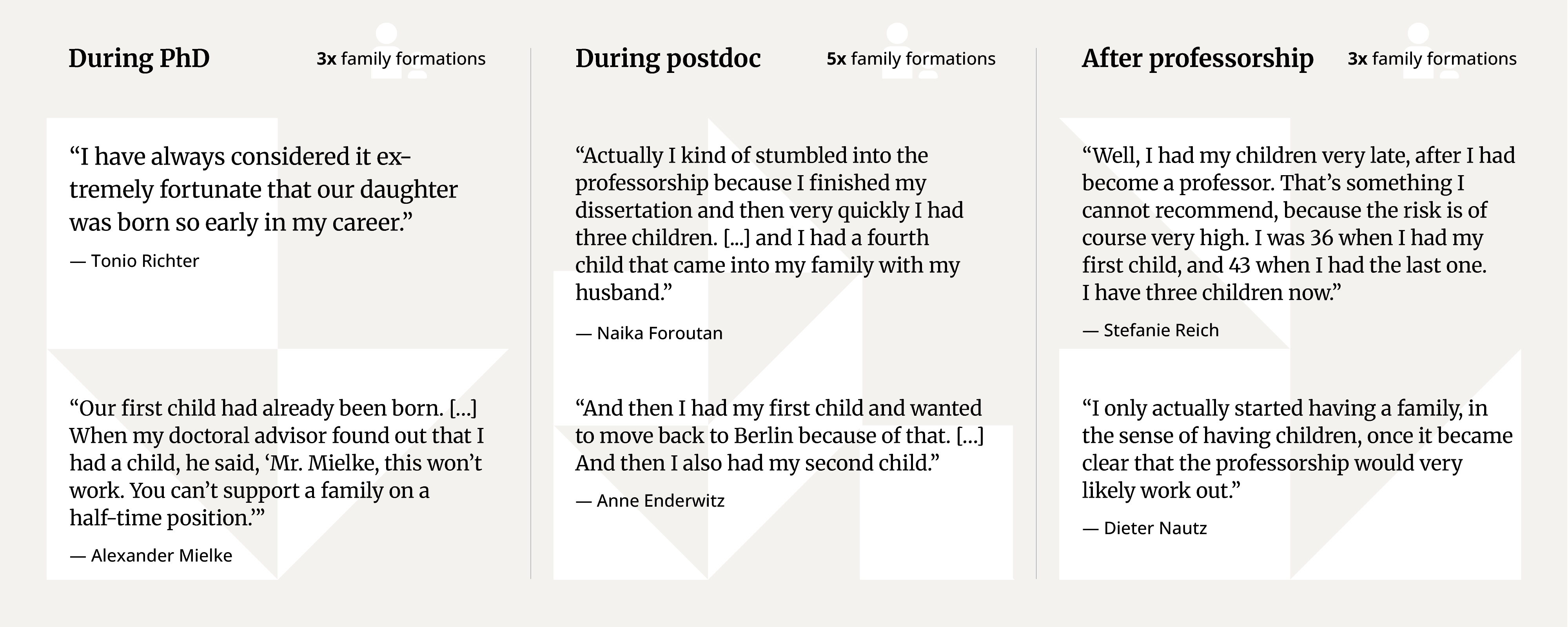
Among our 18 professors, 11 had children, and their experiences varied widely. A clear generational shift emerged: younger professors, particularly women, reported that having children was increasingly seen not as a disqualification — but sometimes as a positive signal.
“From my perspective at the time, I naturally felt: I’m a woman with children, they’ll never take me — but it was actually the opposite.”
— Sina Bartfeld, Professor of Medical Biotechnology
All professors with children mentioned substantial support from partners as essential. This wasn’t something managed solo.
When professors started families relative to their career stage — in their own words.
Chapter 9
The Moment of Decision
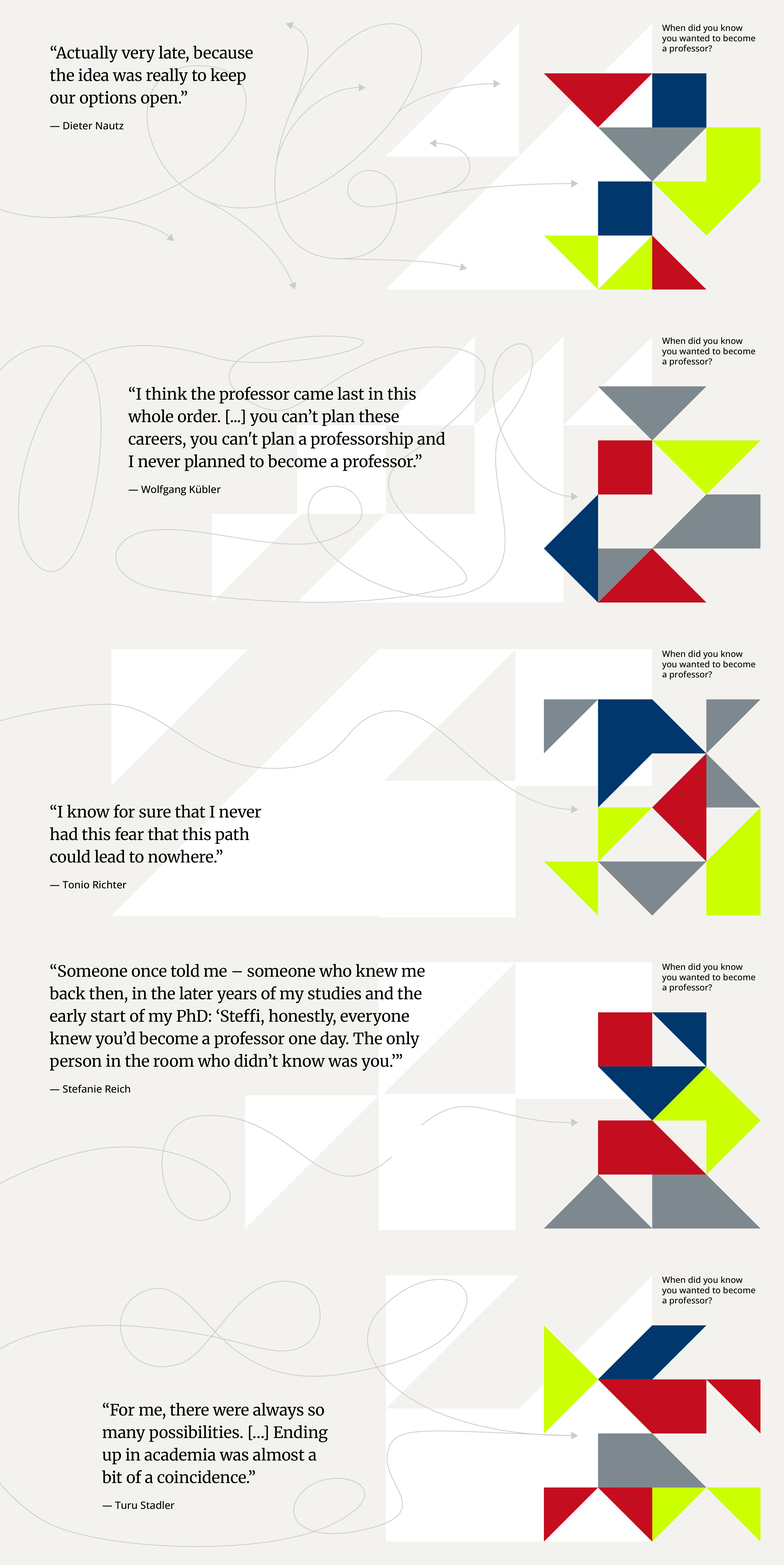
Across all 18 interviews, one question revealed the most: When did you decide? The answers were rarely triumphant. More often, they described a gradual recognition — a slow realization that the work already being done pointed in one direction.
“The Moment of Decision” — how the choice to pursue a professorship evolved across career phases for our 18 interview partners.
What emerges from the data is not a collection of strategic masterminds. It’s a group of deeply engaged researchers who stayed curious, stayed visible, maintained flexibility — and responded effectively when the right moments arrived.
Chapter 10
What This Means for You: Five Strategic Foundations
Our analysis doesn’t prescribe a single path. But it reveals consistent approaches shared by professors across disciplines — not a checklist, but a framework for thinking about your own trajectory.
01
Build Foundations Continuously
Develop skills before you desperately need them. Leadership, teaching, grant writing, communication — not as career accessories, but as genuine capabilities built long before the opportunities arrive.
02
Invest in Visibility and Networks
Physical presence at conferences matters — not just for the talks, but for the conversations afterward. Consistent visibility creates the conditions for luck.
03
Stay Perpetually Prepared
Have current application materials at all times. Opportunities come with short lead times — being prepared converts opportunity into offer.
04
Maintain Strategic Flexibility
Having a Plan B isn’t defeatism — it’s how most professors navigated uncertainty. Keep alternatives viable so your academic decisions are genuine choices, not defaults.
05
Respond Quickly to Windows
When opportunity appears, respond quickly and professionally. The window metaphor is apt: they open, but they don’t stay open indefinitely.
The Reassuring Conclusion
The most important insight from mapping 18 professorial careers: there is no one perfect path to professorship. Almost all our interview partners more or less “stumbled into” their positions, experienced substantial doubts, and maintained alternative plans. That’s not just normal — our data suggests it’s actually characteristic of successful academic careers.
The postdoc years are uncertain by design, not because you’re doing something wrong.
They maintained strategic flexibility while building specific expertise
They created conditions where “chance” could find them through visibility and networks
They responded quickly and effectively when opportunities arose
They worked on problems that genuinely fascinated them
They had mentors, networks, and support systems that mattered at crucial moments
They developed skills beyond research before desperately needing them
They accepted that self-doubt and uncertainty were part of the process, not signs of inadequacy
For Postdocs: The Bottom Line
Don’t wait for certainty or the perfect plan. Build foundations, stay prepared, and remain alert to opportunities. If you’re experiencing doubt, taking detours, or keeping backup plans, you’re not failing at having an academic career — you’re doing it the way most successful professors actually did it.
About This Project
This longread is based on in-depth interviews with 18 professors from the Berlin University Alliance conducted between 2023 and 2025 as part of the podcast series “Pathways to Professorship” (Wege zur Professur). Disciplines represented include English Literature, Materials Science, Physiology, Pediatric Pulmonology, Physics, Applied and Molecular Microbiology, Medical Biotechnology, Law, Mathematics, Egyptology (Coptology), Psychology, Clinical Medicine, and more.